Residual sum of squares что это
Linear Regression


2. Gradient Descent
Gradient is one optimization method which can be used to optimize the Residual sum of squares cost function. There can be other cost functions. Basically it starts with an initial value of β0 and β1 and then finds the cost function. It then increases or decreases the parameters to find the next cost function value. This is done till a minima is found. Gradient descent expects that there is no local minimal and the graph of the cost function is convex.
This is an absolute difference between the actual y and the predicted y. Now, if the units of the actual y and predicted y changes the RSS will change. So, we use the relative term R² which is 1-RSS/TSS
4. TSS — total sum of squares.
Instead of adding the actual value’s difference from the predicted value, in the TSS, we find the difference from the mean y the actual value.
RSS is shown below

TSS is shown below : (Dotted line is ȳ)

5. Relationship between TSS, RSS and R²

TSS works as a cost function for a model which does not have an independent variable, but only y intercept (mean ȳ). This gives how good is the model without any independent variable. When independent variable is added the model performance is given by RSS. The ration of RSS/TSS gives how good is the model as compared to the mean value without variance. Lesser is this ratio lesser is the residual error with actual values, and greater is the residual error with the mean. This implies that the model is more robust. So, 1-RSS/TSS is considered as the measure of robustness of the model and is known as R²
PS : Whenever you compute TSS or RSS, you always take the actual data points of the training set. The difference in both the cases are the reference from which the diff of the actual data points are done. In the case of RSS, it is the predicted values of the actual data points. In case of TSS it is the mean of the predicted values of the actual data points.
6. RSE : Residual squared error = sqrt(RSS/n-2)
7. Assumptions of Linear regression
a. Linear relationship between X and Y
b. Error terms are normally distributed. (Not X and Y).
c. Error terms have zero mean
d. Error terms are independent of each other
e. Error terms have constant variance.
PS — There is no assumption for the distribution of X or Y. It is just about the error terms which are normally distributed.

8. Significance of the coefficients β1, β2,β3..
a. If X is related to Y, we say the coefficients are significant. The stronger is the relation, more significant is the coefficient. If there is no relationship, then the values are not significant.
17 Линейная регрессия
Вы уже умеете считать коэффициент корреляции Пирсона:
), это значит, что перед вами формула. Мы уже сталкивались с формулами ранее, они иногда используются для задания отношений между переменными, например, для определения фасеток на графике (@ref(gg_base)).
Я специально написал “как бы”: если одна переменная предиктор, а другая объясняется этим предиктором, то кажется, что они должны быть обязательно связаны причинно-следственной связью. Это не так: обозначения условны, более того, вы можете поменять переменные местами и ничего не изменится! Короче говоря, линейная регрессия не дает никакой магической каузальной силы исследуемым переменным.
17.1 Функция lm()
Давайте теперь нарисуем регрессионную прямую поверх диаграммы рассеяния:

Функция predict() позволяет скормить модели новые данные и получить предсказания для новых значений предикторов. Попробуем поиграть с этим немного. Допустим, предскажем вес рюкзака для студента весом в 100 кг:
Мы можем даже попробовать какие-нибудь экстремальные значения для предикторов. Например, сколько будет весить рюкзак студента весом 1000 кг?
17.2 Интерпретация вывода линейной регрессии
Гораздо более подробные результаты мы получим, если применим уже известную нам generic функцию summary() на нашу модель.
Это очень мало, мы объяснили всего 3.5846285% дисперсии. Собственно, и p-value больше, чем 0.05.
17.3 Допущения линейной регрессии
Как и в случае с другими параметрическими методами, линейная регрессия имеет определенные допущения относительно используемых данных. Если они не соблюдаются, то все наши расчеты уровня значимости могут некорректными.
Очень важно ставить вопрос о том, насколько результаты будут некорректными. Как сильно нарушения допущений будет влиять на модель? Ответ на этот вопрос может быть контринтуитивен. Например, достаточно большие отклонения от нормальности нам обычно не страшны при условии того, что выборка достаточно большая.
Допущения линейной регрессии связаны с ошибками: они должны быть нормально распределены, а разброс ошибок должен не уменьшаться и не увеличиваться в зависимости от предсказанных значений. Это то, что называется гомоскедастичностью или гомогенностью (когда все хорошо) и гетероскедастичностью или гетерогенностью (когда все плохо).
Зависимость ошибок от предсказанных значений. На что здесь смотреть? На симметричность относительно нижней и верхней части графика, на то, что разброс примерно одинаковый слева и справа.
Q-Q plot. Здесь все довольно просто: если ошибки являются выборкой из нормального распределения, то они выстраиваются в прямую линию. Если это мало похоже на прямую линию, то имеет место отклонение от нормальности.
Scale-Location plot. Этот график очень похож на график 1, только по оси у используются квадратные корни модуля ошибки. Еще один способ исследовать гетеро(гомо)скедастичность и находить выбросы.


17.4 Влияние выбросов на линейную модель

Таким образом, именно экстремальные значения по предиктору, а не по объяснияемой переменной имеют особенно сильное значение на регрессионную модель.
17.5 Множественная линейная регрессия
Поэтому часто используются показатели качества модели, которые “наказывают” модель за большое количество предикторов. Например, adjusted R 2 :
Множественная линейная регрессия имеет еще одно допущение: отсутствие мультиколлинеарности. Это значит, что предикторы не должны коррелировать друг с другом.
Сам VIF-фактор считается на основе полученного R 2 регрессии:
Если Ri 2 большой, то и VIFi выходит большим. Это означает, что предиктор сам по себе хорошо объясняется другими предикторами. Какой VIF считать большим? Здесь нет единого мнения, но если он выше 3 и особенно если он выше 10, то с этим нужно что-то делать.
В нашем случае это не так. Но если бы VIF был большим для какого-либо предиктора, то можно было бы либо попробовать его выкинуть или же использовать анализ главных компонент (см. 21.2), о котором пойдет речь в один из следующих дней.
ANOVA от ANalysis Of VAriance, по-русски часто читается как “АНОВА.”↩︎
Residual Sum of Squares (RSS)
:max_bytes(150000):strip_icc()/adambarone-5c38aef246e0fb0001b36fb9.jpg "Residual sum of squares что это. Смотреть фото Residual sum of squares что это. Смотреть картинку Residual sum of squares что это. Картинка про Residual sum of squares что это. Фото Residual sum of squares что это")
What Is the Residual Sum of Squares (RSS)?
The residual sum of squares (RSS) is a statistical technique used to measure the amount of variance in a data set that is not explained by a regression model itself. Instead, it estimates the variance in the residuals, or error term.
Linear regression is a measurement that helps determine the strength of the relationship between a dependent variable and one or more other factors, known as independent or explanatory variables.
Key Takeaways
Understanding the Residual Sum of Squares (RSS)
In general terms, the sum of squares is a statistical technique used in regression analysis to determine the dispersion of data points. In a regression analysis, the goal is to determine how well a data series can be fitted to a function that might help to explain how the data series was generated. The sum of squares is used as a mathematical way to find the function that best fits (varies least) from the data.
The RSS measures the amount of error remaining between the regression function and the data set after the model has been run. A smaller RSS figure represents a regression function.
The RSS, also known as the sum of squared residuals, essentially determines how well a regression model explains or represents the data in the model.
How to Calculate the Residual Sum of Squares (RSS)
Residual Sum of Squares (RSS) vs. Residual Standard Error (RSE)
The residual standard error (RSE) is another statistical term used to describe the difference in standard deviations of observed values versus predicted values as shown by points in a regression analysis. It is a goodness-of-fit measure that can be used to analyze how well a set of data points fit with the actual model.
RSE is computed by dividing the RSS by the number of observations in the sample less 2, and then taking the square root: RSE = [RSS/(n-2)] 1/2
Special Considerations
Financial markets have increasingly become more quantitatively driven; as such, in search of an edge, many investors are using advanced statistical techniques to aid in their decisions. Big data, machine learning, and artificial intelligence applications further necessitate the use of statistical properties to guide contemporary investment strategies. The residual sum of squares—or RSS statistics—is one of many statistical properties enjoying a renaissance.
Statistical models are used by investors and portfolio managers to track an investment’s price and use that data to predict future movements. The study–called regression analysis–might involve analyzing the relationship in price movements between a commodity and the stocks of companies engaged in producing the commodity.
Finding the residual sum of squares (RSS) by hand can be difficult and time-consuming. Because it involves a lot of subtracting, squaring, and summing, the calculations can be prone to errors. For this reason, you may decide to use software, such as Excel, to do the calculations.
Any model might have variances between the predicted values and actual results. Although the variances might be explained by the regression analysis, the RSS represents the variances or errors that are not explained.
Since a sufficiently complex regression function can be made to closely fit virtually any data set, further study is necessary to determine whether the regression function is, in fact, useful in explaining the variance of the dataset. Typically, however, a smaller or lower value for the RSS is ideal in any model since it means there’s less variation in the data set. In other words, the lower the sum of squared residuals, the better the regression model is at explaining the data.
Residual Sum of Squares FAQs
Is the Residual Sum of Squares the Same as R-Squared?
The residual sum of squares (RSS) is the absolute amount of explained variation, whereas R-squared is the absolute amount of variation as a proportion of total variation.
Is RSS the Same as the Sum of Squared Estimate of Errors (SSE)?
The residual sum of squares (RSS) is also known as the sum of squared estimate of errors (SSE).
What Is the Difference Between the Residual Sum of Squares and Total Sum of Squares?
The total sum of squares (TSS) measures how much variation there is in the observed data, while the residual sum of squares measures the variation in the error between the observed data and modelled values. In statistics, the values for the residual sum of squares and the total sum of squares (TSS) are oftentimes compared to each other.
Can a Residual Sum of Squares Be Zero?
The residual sum of squares can be zero. The smaller the residual sum of squares, the better your model fits your data; the greater the residual sum of squares, the poorer your model fits your data. A value of zero means your model is a perfect fit.
Sum of Squares Total, Sum of Squares Regression and Sum of Squares Error
You may be wondering what all of those sums of squares are all about. Maybe that’s what got you here in the first place. Well, they are the determinants of a good linear regression. This tutorial is based on the ANOVA framework you may have heard before.
Before reading it, though, make sure you are not mistaking regression for correlation. If you’ve got this checked, we can get straight into the action.
A quick side-note: Want to learn more about linear regression? Check out our explainer videos The Linear Regression Model. Geometrical Representation and The Simple Linear Regression Model.
SST, SSR, SSE: Definition and Formulas
There are three terms we must define. The sum of squares total, the sum of squares regression, and the sum of squares error.

What is the SST?
The sum of squares total, denoted SST, is the squared differences between the observed dependent variable and its mean. You can think of this as the dispersion of the observed variables around the mean – much like the variance in descriptive statistics.
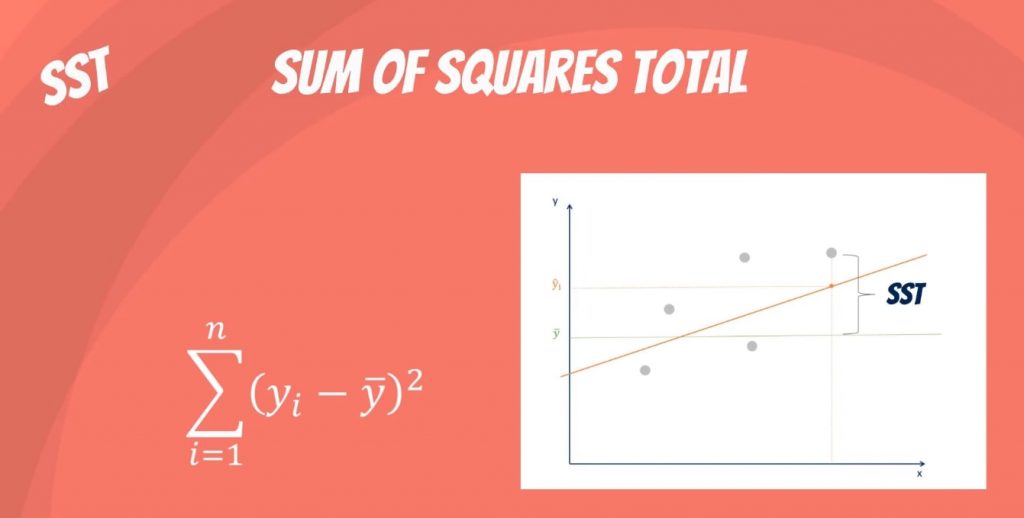
It is a measure of the total variability of the dataset.
Side note: There is another notation for the SST. It is TSS or total sum of squares.
What is the SSR?
The second term is the sum of squares due to regression, or SSR. It is the sum of the differences between the predicted value and the mean of the dependent variable. Think of it as a measure that describes how well our line fits the data.
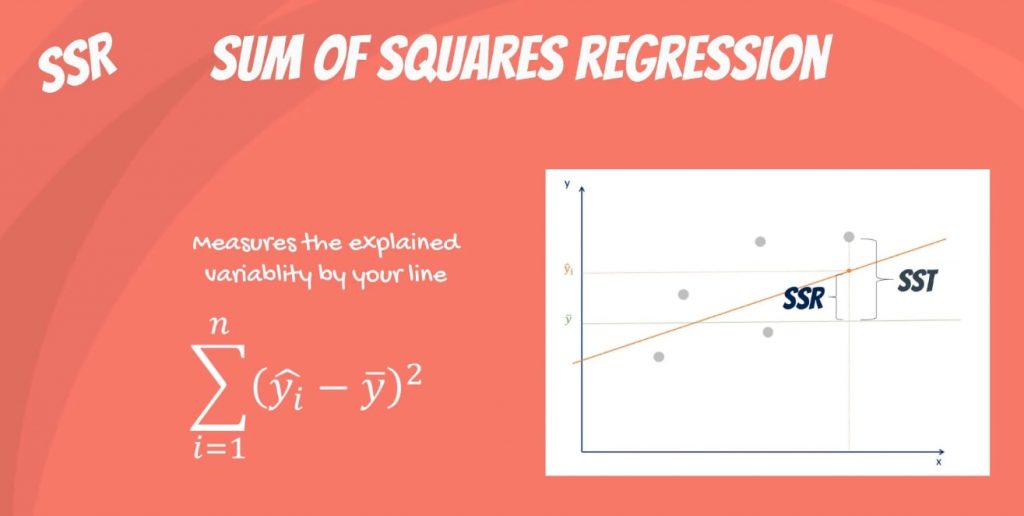
If this value of SSR is equal to the sum of squares total, it means our regression model captures all the observed variability and is perfect. Once again, we have to mention that another common notation is ESS or explained sum of squares.
What is the SSE?
The last term is the sum of squares error, or SSE. The error is the difference between the observed value and the predicted value.
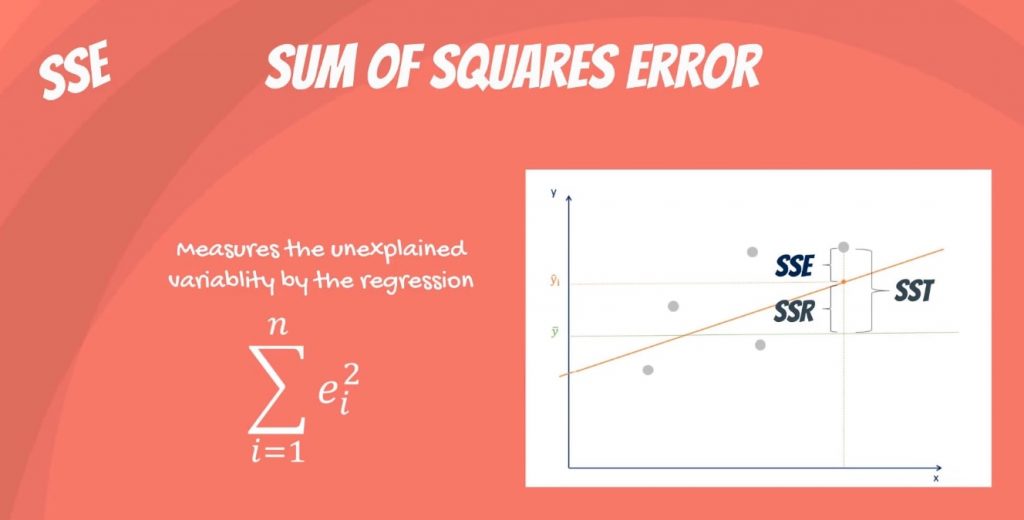
We usually want to minimize the error. The smaller the error, the better the estimation power of the regression. Finally, I should add that it is also known as RSS or residual sum of squares. Residual as in: remaining or unexplained.
The Confusion between the Different Abbreviations
It becomes really confusing because some people denote it as SSR. This makes it unclear whether we are talking about the sum of squares due to regression or sum of squared residuals.

In any case, neither of these are universally adopted, so the confusion remains and we’ll have to live with it.
Simply remember that the two notations are SST, SSR, SSE, or TSS, ESS, RSS.

There’s a conflict regarding the abbreviations, but not about the concept and its application. So, let’s focus on that.
How Are They Related?
Mathematically, SST = SSR + SSE.

The rationale is the following: the total variability of the data set is equal to the variability explained by the regression line plus the unexplained variability, known as error.

Given a constant total variability, a lower error will cause a better regression. Conversely, a higher error will cause a less powerful regression. And that’s what you must remember, no matter the notation.
Next Step: The R-squared
Well, if you are not sure why we need all those sums of squares, we have just the right tool for you. The R-squared. Care to learn more? Just dive into the linked tutorial where you will understand how it measures the explanatory power of a linear regression!
Interested in learning more? You can take your skills from good to great with our statistics course.
Learn data science with industry experts

Iliya Valchanov
Co-founder of 365 Data Science
Iliya is a Finance Graduate from Bocconi University with expertise in mathematics, statistics, programming, machine learning, and deep learning. His passion for teaching inspired him to create some of the most popular courses in our program: Introduction to Data and Data Science, Introduction to R Programming, Statistics, Mathematics, Deep Learning with TensorFlow, Deep Learning with TensorFlow 2, and Machine Learning in Python.